Culture, Tradition, Gastronomy
A route that explores festivals, markets, local products and cultural spaces in Betanzos, highlighting its traditions, gastronomy and popular life.
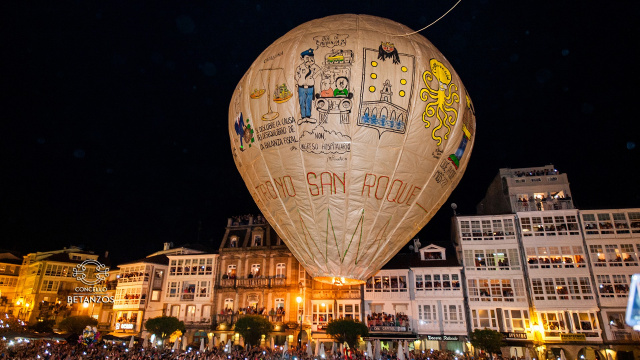
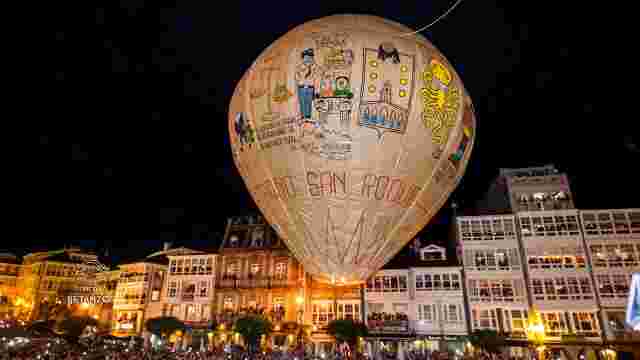
San Roque Balloon
The origin of the aerostatic tradition can be traced back to a celebration held in 1814, specifically on 29 May, on the occasion of the name day of King Ferdinand VII, when the people of Betanzos launched a paper balloon into the sky to commemorate the event. This act took place in the fairground, now the Plaza of the García Naveira Brothers, and chronicles recount that the launch caused great admiration among the crowd gathered that day. This milestone, quite common in festivities of the time, was repeated again in 1837 with the launch of two aerostats to celebrate the drafting of a new constitutional text. The first reference to the paper balloon linked to celebrations in honour of Saint Roch appears in 1834. That year, the Betanzos City Council spent 78 reales on treating all the young men who worked on making the balloons to punch and refreshments. In addition to these expenses, the Municipal Archive of Betanzos preserves a list of the products purchased for this purpose, including oil, wrapping paper, tow, pitch, twine, flour and reams of paper. These balloons, made by local residents, already carried small baskets that released fireworks. More detailed records begin to appear in the second half of the century. For example, the Municipal Archive of Betanzos preserves a file containing an invoice from 1866 in which Luis Abella was paid “80 escudos for the construction of two aerostatic balloons”. These two balloons were most likely launched on the nights of 15 and 16 August, being identified in the documentation as the small balloon and the large balloon. The amount increased in 1868, when the same builder was paid 96 escudos for the construction of three aerostats, launched on this occasion, from smaller to larger, on the nights of 14, 15 and 16 August. Luis Abella was later replaced by Antonio Pedreira, who appears in the documentation as a “balloon launcher” at the 1872 festivities, receiving payment for the making of three paper balloons. There is then a gap in the documentation until 1875, when the appearance of Claudino Pita Pandelo is recorded for the first time. This 16-year-old youth was responsible for maintaining the tradition, introducing modifications to the balloon and ensuring its continuity. Despite being a postal worker, he had a workshop in the former convent of San Domingo, where he produced the device that presided over all the festivities.